
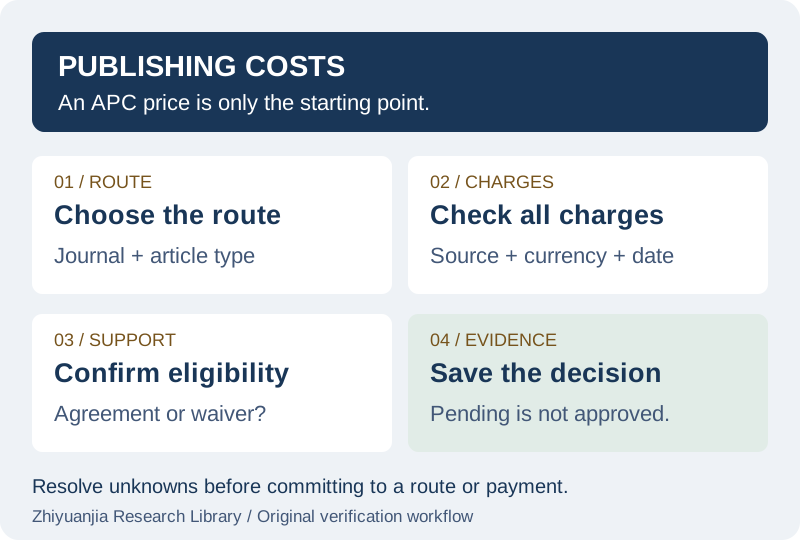
Not every journal requires an article processing charge (APC), and an APC listed on a website is not necessarily the amount you personally owe. Check the exact journal and publishing route, other author charges, and any confirmed institutional coverage or waiver. Keep an unapproved funding request separate from an approved payment arrangement.
When to use this guide
You have shortlisted a journal, but its website mentions open access, a subscription option, an APC or a university agreement. You need to establish what applies to this article before committing to a submission or payment.
1. Identify the journal and the route you would actually use
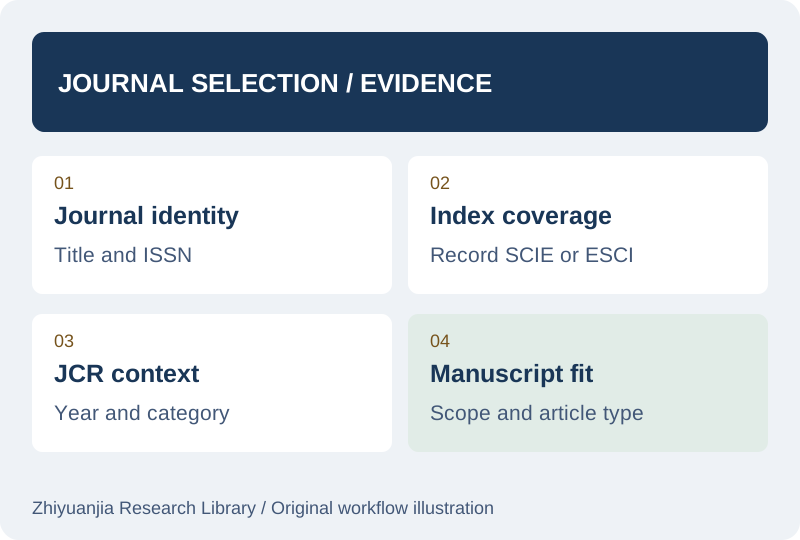
Start with the official journal page and record the title, ISSN, article type and check date. A hybrid journal offers both subscription and open-access publication. Springer Nature explains that most of its subscription publications have no publishing charge, while an open-access article in a hybrid journal carries an APC. This is that publisher’s guidance, not a universal promise about every journal. Our evidence sheet keeps the route beside the fee: a price for optional open access should not silently become the cost of every available route. Ask your library whether your intended route meets any applicable funder requirements.
2. Record all charges, not just a headline APC
Make separate entries for submission, publication, page, colour and other stated charges. Springer Nature notes that colour, length or page charges can apply to subscription publication. DOAJ requires journals applying for inclusion to disclose author charges across the submission-to-publication process, including an explicit statement when none apply. Our comparison sheet adds the quoted currency, any stated taxes, the official source and the date checked. Mark an unclear item as unresolved rather than zero. When two official pages disagree, send their URLs to the publisher and ask which terms apply to your article type and intended route.
3. Keep no-APC open access in the comparison
Open access describes access and reuse conditions; it does not by itself establish that an author must pay. DOAJ’s criteria accommodate journals with no author charges as well as journals that declare fees. Use an appropriate directory record as a starting point, then revisit the journal’s own instructions and fee statement. Our shortlist still checks the research question, readership and article type. A low price or no-fee label cannot answer those fit questions, and DOAJ inclusion is not a substitute for a separate SCIE, ESCI or institutional-recognition check. Save the evidence rather than relying on a badge copied into an invitation email.
4. Treat a university agreement as an eligibility question
Wiley explains that institutional or funder accounts may cover APCs in full or in part. Its individual agreement entries specify conditions such as the responsible corresponding author’s affiliation, journal portfolio, article type and relevant submission or acceptance dates. Some entries also make coverage dependent on approval and remaining allocations. Our recommended question to the library is specific: does this agreement cover this journal, this article type and this corresponding author at the relevant date? Record the reply, any author contribution and the approval status. Being able to read a journal through your library is not evidence that this article’s APC has been approved.
5. Check the waiver procedure before assuming a discount
Nature Support’s guidance for discretionary APC support concerns financial need in fully open-access journals. It asks authors to raise the request at manuscript submission and explains that selecting an interest box alone does not complete it: a separate request must follow. The page currently specifies completion within 14 days and case-by-case consideration. Recheck the target policy; that deadline is not a rule for other publishers. Our workflow records the request channel, deadline, documents requested and written outcome. Do not enter a requested discount as approved funding, or invent an affiliation or hardship statement to obtain support.
6. Make the unresolved amount visible before committing
Consider a hypothetical shortlist with three candidates: one has a clearly documented no-fee route; another lists an APC with institutional approval pending; a third has a fee page that does not identify your article type. Label them “documented route”, “coverage pending” and “fee clarification needed”. Do not assign invented prices or treat the latter two as free. This is our comparison method, not a publisher classification. Discuss which uncertainty the author team can resolve and who will do it. Keep scientific suitability in a separate column so that an apparently affordable option does not bypass the manuscript-fit check.
7. Recheck the terms at the decision point
Before submission, and again when asked to choose a publication route or pay, compare the journal identity, article type, selected route and approved support with your evidence sheet. We recommend confirming an unexpected invoice or changed payment instruction through a contact reached from the official publisher website. Keep the author team and the institution’s responsible office informed of unresolved charges. The useful deliverable is a dated record of what is confirmed, what remains conditional and what needs an answer; a saved price screenshot alone cannot resolve all three.
Zhiyuanjia official Q&A
Prepared by our company for this guide; these are not reader comments and do not count as discussion.
Does “no APC” mean there can be no other author charges?
No. Check the full fee statement rather than the APC field alone. DOAJ’s transparency criteria cover charges from submission through publication; Springer Nature also identifies possible colour, length or page charges. In our worksheet, an unspecified fee remains unresolved until clarified.
Is my university appearing on a publisher’s list enough to confirm coverage?
No. Read the individual agreement and obtain the required confirmation for the actual article. Wiley’s entries distinguish eligibility conditions, and some depend on approval and available allocations. We keep “request pending” separate from “approved”, rather than assuming a university name settles the payment.
Submission checklist
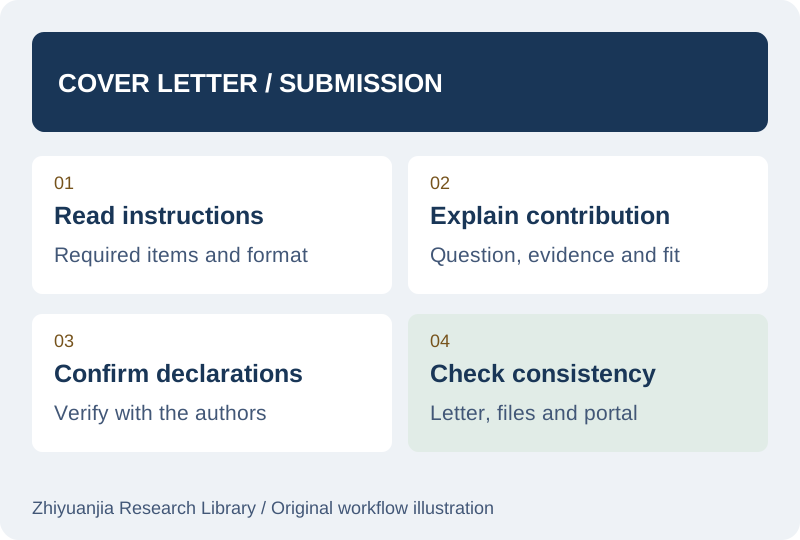
- Match the official journal, ISSN, article type and intended publishing route.
- Record each stated charge, currency, source, check date and unresolved item.
- Check whether the exact article and corresponding author qualify for institutional coverage.
- Complete any waiver request through the stated process and keep the written outcome.
- Recheck the selected route and confirmed support before committing or paying.
Scope and limitations
This guide explains a verification workflow, not a fee quotation, funding approval or promise of acceptance. Publisher examples apply only within their stated scope. Journal charges, agreements and waiver procedures may change. Authors and their institution must confirm the terms and any funder requirements that apply to the actual article.
Editorial responsibility
Prepared by Zhiyuanjia International Education as an organizational publication. No named specialist review has been publicly documented for this page.
Sources, attribution and corrections policy (Chinese) ↗Official sources
Source pages checked on 2026-11-02. Recheck the target journal's current instructions before submission. Steps described as our workflow are practical suggestions, not publisher requirements.
Need help applying these checks to your manuscript?
Explore journal matching and submission checks (Chinese interface) ↗Reads accumulate from launch, deduplicated per network IP and Beijing calendar day. They are not a count of unique people or completed readings. No login needed to like. A browser identifier prevents repeats for up to 90 days. At most one like per article per network IP each day, and 20 likes per IP daily.
Reader discussion
No login required. Comments appear anonymously only after administrator approval. Do not include personal, patient or confidential research information.
Anonymity, moderation and retention
Only a generated nickname is public; email, school, phone and IP are not shown. An anonymous identification cookie lasts 90 days and allows withdrawal and helps prevent repeated likes in this browser. Like identifiers expire within 90 days; daily IP hashes for likes are cleared after two days while aggregate counts remain. If you clear it, contact an administrator to request removal. Non-approved comments are removed within 30 days; public comments are retained for up to 365 days. The service stores daily IP hashes for rate limits, not raw IPs in the comment database. Wait at least 90 seconds between submissions. Daily limits: 10 per anonymous identity/account, 20 per shared IP and 100 across the site. Shared campus networks share their IP limit. Spam will not be published.