
No. A JCR quartile and an index designation describe different things. An ESCI journal can appear in a ranked JCR science or social-science category. If your institution requires SCIE, verify SCIE coverage separately; an impact factor or Q1 label is not sufficient proof.
When to use this guide
You have found a journal advertised as Q1, but your degree, funding or promotion rule specifically mentions SCI or SCIE. Use this guide before treating that journal as eligible or paying any publication-related charge.
1. Write down the requirement before looking at a ranking
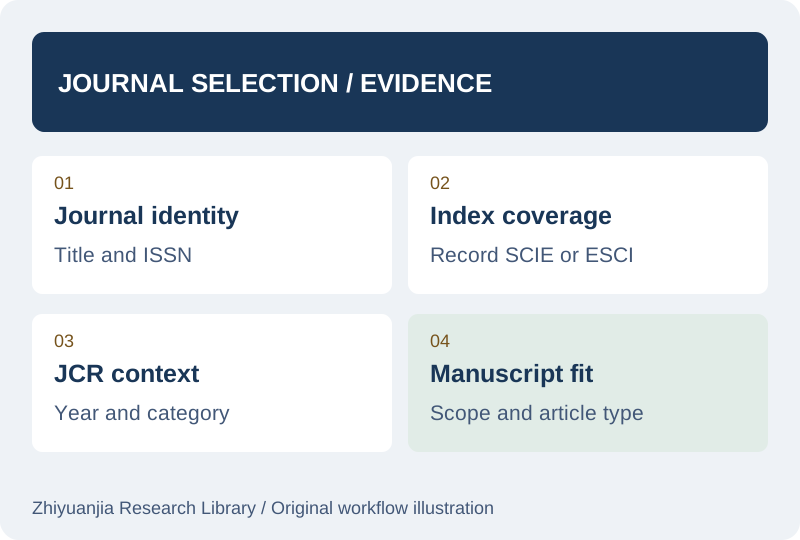
Our suggested starting point is a short requirement sheet. Copy the actual rule from your institution and identify who interprets it. Does “SCI” mean SCIE in this policy? Which publication date matters? Which metric year and subject category should you use? Ask the responsible office to clarify missing conditions in writing. A journal recommendation cannot resolve an ambiguous institutional rule. Keep the answer with your shortlist so a later reviewer can see why you considered a candidate eligible.
2. Treat the index and the quartile as separate records
Clarivate explained that its 2024 JCR release unified rankings across relevant editions in science and social-science categories, including ESCI. This means membership of a ranked category does not by itself identify the journal as SCIE. Record the exact coverage label shown in the Master Journal List, then check the JCR information separately. Do not substitute Scopus coverage, a publisher logo or the existence of an impact factor for the required Web of Science index. This guide does not assert the current coverage of any particular title.
3. Match the journal identity before collecting evidence
We recommend matching the full journal name, print ISSN and electronic ISSN against the publisher’s own journal page. Similar titles, title changes and unofficial submission sites can otherwise lead you to the wrong record. Add the official journal URL and the date you checked it to your evidence sheet. If identifiers disagree, leave the candidate unresolved and investigate. A screenshot of a ranking without an identifiable journal is weak evidence for a submission decision, even if the ranking itself looks convincing.
4. Preserve the year and category instead of a bare “Q1”
For our comparison workflow, use separate columns for the metric year, JCR subject category, displayed quartile, source and check date. If multiple categories are listed, preserve the relevant results rather than silently choosing the most favourable one. Ask your institution which category it accepts. Do not put a CiteScore or SJR quartile in a JCR column. If access restrictions prevent verification, write “not yet verified” and identify what record is needed. An AI-generated answer is a lead for checking, not a substitute for that record.
5. Apply the rule without upgrading uncertain candidates
Consider this hypothetical situation: a candidate has a Q1 claim, while the coverage record identifies ESCI and your written requirement accepts only SCIE. Keep it out of the confirmed eligible list. You may retain it in a clearly separate alternatives list if the author wants to discuss relaxing the requirement, but do not quietly relabel it. The same approach applies when a source is missing or conflicting: uncertainty stays visible. Keep the evidence sheet even when you reject a candidate, so the decision can be explained later.
6. Check manuscript fit after eligibility
Eligibility is only one filter. Our final shortlist also compares the research question, methods, audience and article type with the journal’s current aims, scope and author instructions. An eligible journal may still be unsuitable for your study. Before submission, repeat the checks that may have changed and record the new date. Keep fees and open-access choices in their own columns; neither proves index coverage. A useful shortlist tells you what has been verified, what remains uncertain and what the authors need to decide.
Zhiyuanjia official Q&A
Prepared by our company for this guide; these are not reader comments and do not count as discussion.
Can an ESCI journal have a JCR quartile?
Yes, in eligible science or social-science categories. Clarivate’s 2024 JCR announcement describes unified rankings that include ESCI alongside relevant editions. A quartile therefore does not prove SCIE coverage. Verify the exact index separately and record the JCR year and subject category; do not assume every arts or humanities category has a quartile.
Which JCR category should I use when a journal has more than one?
Record the relevant category results with their metric year and source, then ask the institution responsible for recognition which category and assessment date it accepts. This is our evidence-recording workflow, not a universal institutional rule. Keep missing confirmation visible instead of automatically using the most favourable quartile.
Submission checklist
- Clarify the institution’s accepted index, year and assessment date.
- Match title, ISSN/eISSN and the official publisher page.
- Record the exact coverage label independently of the quartile.
- Preserve JCR year, subject category, source and check date.
- Leave missing evidence unresolved; review scope and article type before submission.
Scope and limitations
This guide supplies a verification workflow, not a guarantee of current indexing, institutional recognition or acceptance. Access to some JCR records may require a legitimate subscription. Recheck official records and your institution’s interpretation at the relevant decision date.
Editorial responsibility
Prepared by Zhiyuanjia International Education as an organizational publication. No named specialist review has been publicly documented for this page.
Sources, attribution and corrections policy (Chinese) ↗Official sources
Source pages checked on 2026-10-31. Recheck the target journal's current instructions before submission. Steps described as our workflow are practical suggestions, not publisher requirements.
Need help applying these checks to your manuscript?
Explore AI journal matching and evidence checks (Chinese interface) ↗Reads accumulate from launch, deduplicated per network IP and Beijing calendar day. They are not a count of unique people or completed readings. No login needed to like. A browser identifier prevents repeats for up to 90 days. At most one like per article per network IP each day, and 20 likes per IP daily.
Reader discussion
No login required. Comments appear anonymously only after administrator approval. Do not include personal, patient or confidential research information.
Anonymity, moderation and retention
Only a generated nickname is public; email, school, phone and IP are not shown. An anonymous identification cookie lasts 90 days and allows withdrawal and helps prevent repeated likes in this browser. Like identifiers expire within 90 days; daily IP hashes for likes are cleared after two days while aggregate counts remain. If you clear it, contact an administrator to request removal. Non-approved comments are removed within 30 days; public comments are retained for up to 365 days. The service stores daily IP hashes for rate limits, not raw IPs in the comment database. Wait at least 90 seconds between submissions. Daily limits: 10 per anonymous identity/account, 20 per shared IP and 100 across the site. Shared campus networks share their IP limit. Spam will not be published.