
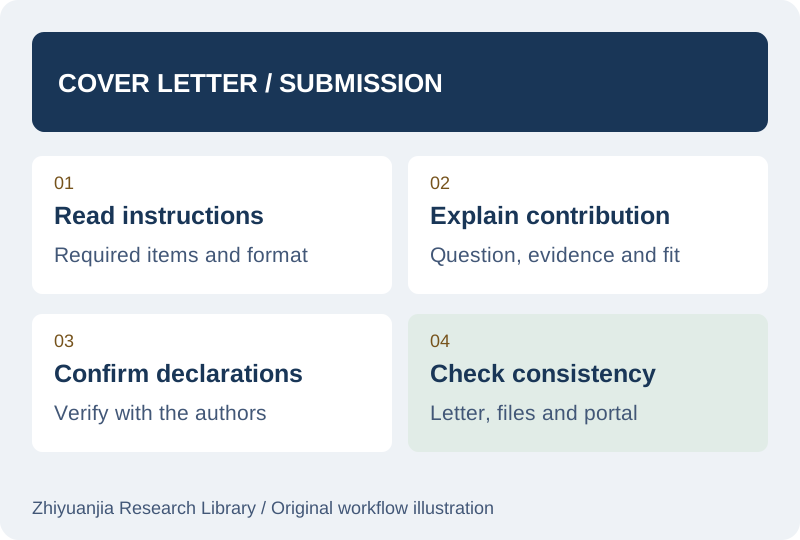
Explain what you are submitting, what the work contributes and why it belongs in this journal. Include the declarations requested by that journal only when they are true. A cover letter introduces the submission; it does not replace the manuscript or guarantee external peer review.
When to use this guide
Your manuscript is ready, but the submission portal asks for a cover letter. You need to explain fit clearly without repeating the abstract, overstating novelty or copying declarations that your co-authors have not confirmed.
1. Read the target instructions before choosing a template
Taylor & Francis notes that cover-letter requirements vary and that some journals do not require one. Nature Support also directs authors to the journal’s own instructions. Our first step is therefore a requirement map: list each requested item, where it belongs and who must confirm it. Check whether the portal expects a file or a text box. Save the source URL and check date. A template is useful only after those decisions; it should not introduce conditions or claims the journal never requested.
2. Give the editor a concise introduction to the work
Nature’s guidance recommends identifying the title and article type, explaining the research question and summarising the main findings and their significance. To prepare that introduction, we suggest writing three evidence-linked notes: the problem investigated, what the authors actually did and what the results allow them to conclude. Build the paragraph from those notes. If the study is exploratory or observational, keep that limitation visible. Replace unsupported claims such as “the first definitive proof” with a specific contribution you can defend from the manuscript.
3. Make the journal-fit statement specific
A useful fit statement connects a feature of the study to the journal’s stated scope or readership. Our practical test is to replace the journal name with a different title: if the sentence still works unchanged, it is probably too generic. Identify the actual audience, method or application that makes the connection meaningful. You do not need praise about prestige or impact. The fit argument should be consistent with the article type you selected in the portal and with the scope evidence used when you shortlisted the journal.
4. Confirm declarations instead of pasting them blindly
Nature’s guidance includes originality, absence of simultaneous consideration elsewhere and author approval, along with relevant disclosures. A declaration must describe the real submission. Ask the corresponding author and co-authors to confirm the facts before including it. Check the target policy for preprints, related work, conflicts of interest and any ethical information it requests. If related manuscripts or prior editorial discussions must be disclosed, describe them accurately. Do not automatically assert that there are no conflicts or no related submissions simply because a sample letter says so.
5. Use a short structure and remove abstract duplication
Taylor & Francis advises against copying the abstract and recommends straightforward language and a brief letter, normally no longer than one page. Within those instructions, our suggested draft has an identification sentence, a contribution paragraph, a fit paragraph and the required declarations and contact details. Treat this as a working outline, not mandatory wording. Avoid long technical background that the manuscript already supplies. Every sentence should either orient the editor, explain a supported contribution, establish fit or supply information the submission process requires.
6. Compare the letter with the files you will actually submit
Our final check is a four-way comparison between the letter, title page, manuscript and portal entries. Verify the journal name, title, article type, author details and corresponding-author address. Check that numerical or novelty claims in the letter are supported by the submitted version. Remove placeholders and references to a previous target journal. Ask a co-author to review statements that bind the author group. Keep the final letter alongside the submitted files; if the journal later asks a question, you can identify exactly what was represented at submission.
Zhiyuanjia official Q&A
Prepared by our company for this guide; these are not reader comments and do not count as discussion.
Should I paste my abstract into the cover letter?
Taylor & Francis advises against copying the abstract into the letter. Introduce the supported contribution and explain the connection to the journal’s readership in concise language. Check that the letter agrees with the submitted manuscript, and avoid stronger novelty or causal claims than the research supports.
Does every journal require a cover letter?
No. Taylor & Francis explains that some journals do not require one, and requirements vary. Read the target journal’s current instructions and portal fields first. Where a letter is requested, Nature’s guidance provides a useful checklist, but the target journal determines the required format, declarations and disclosures.
Submission checklist
- Check the current journal instructions and required submission format.
- Identify the title, article type and research question accurately.
- Explain the supported contribution and a specific scope/readership connection.
- Confirm declarations with the responsible authors and disclose relevant circumstances.
- Compare the letter, title page, manuscript and portal before submitting.
Scope and limitations
This is a preparation workflow, not a promise that a letter will secure peer review or acceptance. Journal-specific instructions override the suggested outline. Authors remain responsible for the accuracy of declarations, disclosures and scientific claims.
Editorial responsibility
Prepared by Zhiyuanjia International Education as an organizational publication. No named specialist review has been publicly documented for this page.
Sources, attribution and corrections policy (Chinese) ↗Official sources
Source pages checked on 2026-10-31. Recheck the target journal's current instructions before submission. Steps described as our workflow are practical suggestions, not publisher requirements.
Need help applying these checks to your manuscript?
Review submission preparation and journal support (Chinese interface) ↗Reads accumulate from launch, deduplicated per network IP and Beijing calendar day. They are not a count of unique people or completed readings. No login needed to like. A browser identifier prevents repeats for up to 90 days. At most one like per article per network IP each day, and 20 likes per IP daily.
Reader discussion
No login required. Comments appear anonymously only after administrator approval. Do not include personal, patient or confidential research information.
Anonymity, moderation and retention
Only a generated nickname is public; email, school, phone and IP are not shown. An anonymous identification cookie lasts 90 days and allows withdrawal and helps prevent repeated likes in this browser. Like identifiers expire within 90 days; daily IP hashes for likes are cleared after two days while aggregate counts remain. If you clear it, contact an administrator to request removal. Non-approved comments are removed within 30 days; public comments are retained for up to 365 days. The service stores daily IP hashes for rate limits, not raw IPs in the comment database. Wait at least 90 seconds between submissions. Daily limits: 10 per anonymous identity/account, 20 per shared IP and 100 across the site. Shared campus networks share their IP limit. Spam will not be published.